Can You Get Dental Implants on the NHS? (2026 Guide)

The Safe Smile Team
Short answer: rarely. Dental implants on the NHS do exist, but they're reserved for a small group of patients with an exceptional clinical need, and the decision is made in a hospital setting rather than at your local dental practice.
For almost everyone else, implants are a private treatment.
That's a frustrating answer if you've just been told you need one. So in this guide we'll explain exactly when the NHS does fund implants, why most people don't qualify, what the NHS offers instead, and what you can realistically expect to pay privately in the UK.
When Does the NHS Fund Dental Implants?
The NHS funds implants where tooth loss is linked to a serious medical situation and no other tooth replacement would restore proper function. In practice, the cases that tend to qualify include:
- Reconstruction after mouth or head and neck cancer treatment
- Severe facial trauma, for example after a road accident
- Teeth missing from birth due to a congenital condition such as ectodermal dysplasia or cleft palate
- Situations where dentures genuinely cannot be worn, sometimes following jaw surgery
Even within these categories, funding is assessed case by case. Meeting one of the criteria doesn't guarantee approval.
The route matters too. Your local NHS dentist can't simply prescribe you an implant. These cases go through a hospital referral, usually to a consultant in restorative dentistry or oral and maxillofacial surgery, who then puts the case forward under strict local commissioning rules.
You can read the NHS's own guidance on what dental treatment is available at nhs.uk.
Why Most People Don't Qualify

Here's the honest bit. If you've lost a tooth to decay, gum disease or simple wear and tear, you almost certainly won't get an implant funded by the NHS. That covers the vast majority of adults searching for this.
It isn't personal, and it isn't your dentist being unhelpful. The NHS works on the principle of restoring function at the lowest clinically appropriate cost. If a denture or a bridge can get you eating and speaking comfortably again, that's what the NHS will offer, because an implant costs the service many times more per patient.
Quality of life arguments, sadly, don't tend to change the outcome. Wanting a fixed tooth rather than a removable denture is completely reasonable. It just isn't enough to meet the threshold of exceptional clinical need.
What the NHS Offers Instead for Missing Teeth
Missing teeth options on the NHS come under Band 3, the highest charge band. In England, a Band 3 course of treatment costs £332.10 (the rate from 1 April 2026, and you can check the current figure on nhs.uk). Rates differ in Scotland, Wales and Northern Ireland.
For that single charge, the NHS can provide:
- Dentures, either partial or full. Removable, functional, and by far the most common NHS tooth replacement.
- Bridges, where a false tooth is anchored to the teeth either side of the gap. These require healthy neighbouring teeth and usually involve reshaping them.
Both do a job. Plenty of people get on fine with a well-made denture. But neither replaces the tooth root, which is why bone in the jaw gradually shrinks under a denture over the years, and why bridges put extra load on the anchor teeth. Implants are the only option that replaces the root itself.
That's the main reason so many patients end up looking at private treatment even though an NHS option exists.
What Do Dental Implants Cost Privately?

This is usually the next question, and the gap is smaller than a lot of people assume.
Through our partner clinic model at Safe Smile Implants, a single tooth implant starts from £1,299, and full arch treatment starts from £7,999. Your exact price follows your personal assessment, since factors like bone volume and the number of implants needed vary from person to person.
We also offer 0% finance through Medenta, so the cost can be spread rather than paid in one go.
For a proper breakdown of what's included in an implant price, what pushes it up or down, and the questions to ask any provider before you commit, read our full guide to dental implant costs in the UK.
One honest caution while we're on cost. If a quote looks dramatically lower than the UK norm, especially from overseas, look very closely at what it includes.
Aftercare, imaging, the implant brand and who fixes things if they go wrong all matter enormously with this treatment.
NHS vs Private Implants: The Honest Comparison
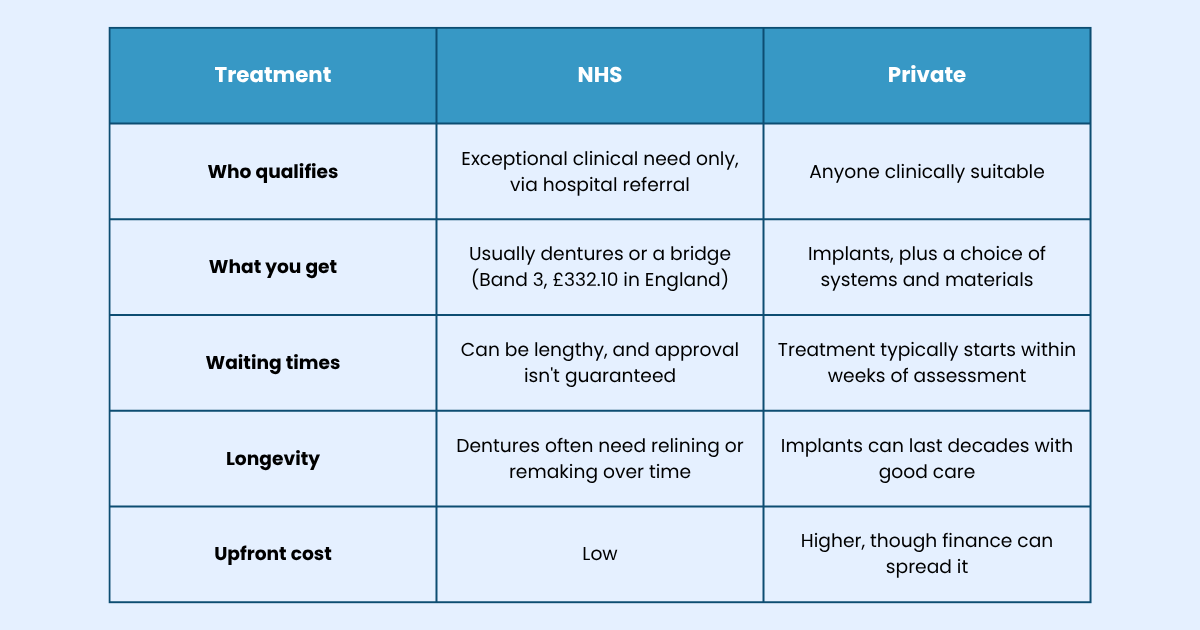
We're not here to knock the NHS. It does exactly what it's designed to do, which is restore basic function affordably for the people who need it most. The comparison really comes down to what each route is set up to deliver.
If you meet the NHS criteria, pursue that route first. Ask your dentist about a hospital referral and get a clear answer on your eligibility before spending anything privately.
If you don't qualify, which is the reality for most, the sensible next step is a proper private assessment so you know your actual options and your actual price.
Not Sure Where You Stand? Start With a Free Assessment
If you've read this far, you probably already suspect the NHS route isn't open to you. The good news is that finding out your real options costs nothing.
You can book a free e-consultation with our team, talk through your situation with an Implant Journey Manager, and get a personalised treatment plan with a clear price before you commit to anything.
No pressure, no obligation, just a straight answer about what's possible for your smile.
Frequently asked questions
Are dental implants covered by the NHS?
Only in exceptional cases with a proven clinical need, such as reconstruction after mouth cancer, severe facial trauma, or congenitally missing teeth. Routine tooth loss doesn't qualify. Funding decisions are made through hospital services rather than high street NHS dentists.
How much do dental implants cost on the NHS?
If you qualify, implant treatment falls under Band 3, which is £332.10 in England from April 2026. But qualifying is the hard part. The overwhelming majority of implant patients in the UK pay privately, where a single implant typically starts from around £1,299.
Can I get dental implants on the NHS if I'm on benefits?
Being on benefits can exempt you from NHS dental charges, but it doesn't change the clinical criteria. Eligibility for NHS implants is based on medical need, never on income. If you don't meet the clinical threshold, benefits won't unlock implant funding.
What does the NHS offer for missing teeth if implants aren't available?
Dentures and bridges, both under the Band 3 charge. These restore appearance and basic function, though they don't replace the tooth root, so they behave differently to implants over the long term.
How do I get referred for NHS dental implants?
Speak to your NHS dentist first. If they believe you may meet the criteria, they can refer you to a hospital consultant in restorative dentistry or maxillofacial surgery, who assesses your case against local commissioning rules. Be prepared for a wait, and for the possibility that funding is declined even with a referral.
This article is for general information only and is not dental or medical advice. Treatment suitability varies from person to person - always consult a qualified dental professional about your specific circumstances.
Wondering what this means for your smile?
Talk it through with the team in a free online video consultation. No pressure, no obligation - just clear answers about your options and costs.
- Free and with no obligation
- UK-qualified, GDC-registered dentists
- Relaxed video chat, from home